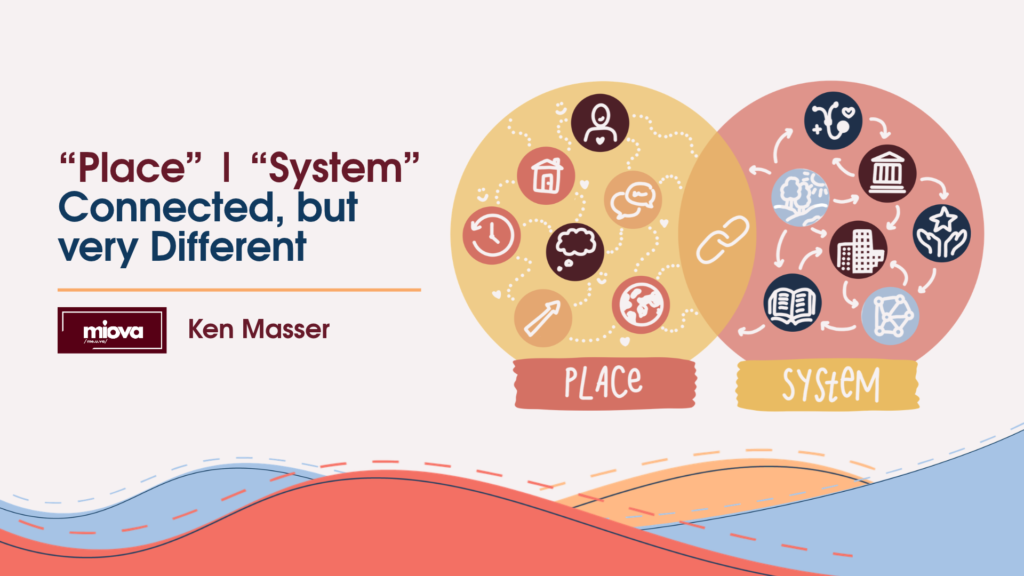
“We’ve been doing place based working for years.” It’s an understandable response to the rising tide and popularity of “whole system, place based approaches”, and its one I hear regularly. The experience colleagues and organisations have in place really matters. But, in the context of a growing narrative around systems thinking and systems leadership the claim that we’ve always been working this way invites a useful question.
Are “place based” and “system” approaches the same thing?
For local leaders and national bodies trying to navigate their way through systems and place, the difficulty is that “place based working” and “whole systems approaches” have become almost interchangeable or synonymous in much of our conversation. They sit alongside one another in strategies and funding applications, often separated only by a slash that suggests: choose whichever terminology you want.
That slash is doing quite a lot of intellectual heavy lifting, and it’s a problem.
These two ideas or approaches do belong together, but they arent the same. They overlap substantially. But treating them as synonyms makes it easier to assume that working collaboratively in a place means we are already working systemically.
Place based working takes the particularities of a place, town, village or borough seriously and recognises that local context is critical. The history, identities, relationships, inequalities and possibilities in a place are part of its unique heritage, identity and future. Place based work recognises that what makes sense in one neighbourhood may make very little sense two miles down the road, however enthusiastic the case study.
At its best, the place shapes the work. People who live there influence priorities, resources and decisions. Questions of power, relationships and wider influences are already part of good place based practice.
Systems approaches are connected but in some ways quite different. A systemic approach brings particular attention to how those influences interact, and the patterns that emerge from those interactions. How decisions made in one part of the picture affect possibilities elsewhere. Why seemingly sensible actions by individual organisations can sometimes produce collectively disappointing results. A systemic approach would pose the question: how do our own and collective responses change the situation we are trying to improve?
Place and systems are different emphases, overlapping in some ways, but distinctly different in others. The distinction is one of emphasis, not a hierarchy of sophistication. Place based practice can challenge systemic conditions, and systems practice can operate at a very local scale.
There is perhaps a third distinction worth making. Working in a place is not necessarily the same as working with a place-based approach. Much of our traditional programme delivery is geographically targeted. We identify a need, commission an intervention, deliver activity and measure the results. There is nothing inherently wrong with that, and it can achieve important outcomes. But locating a programme within a particular neighbourhood doesn’t automatically mean the priorities, relationships, assets or power dynamics of that place have fundamentally shaped the work. Nor does it mean we’ve examined the wider system producing the outcomes we’re trying to change.
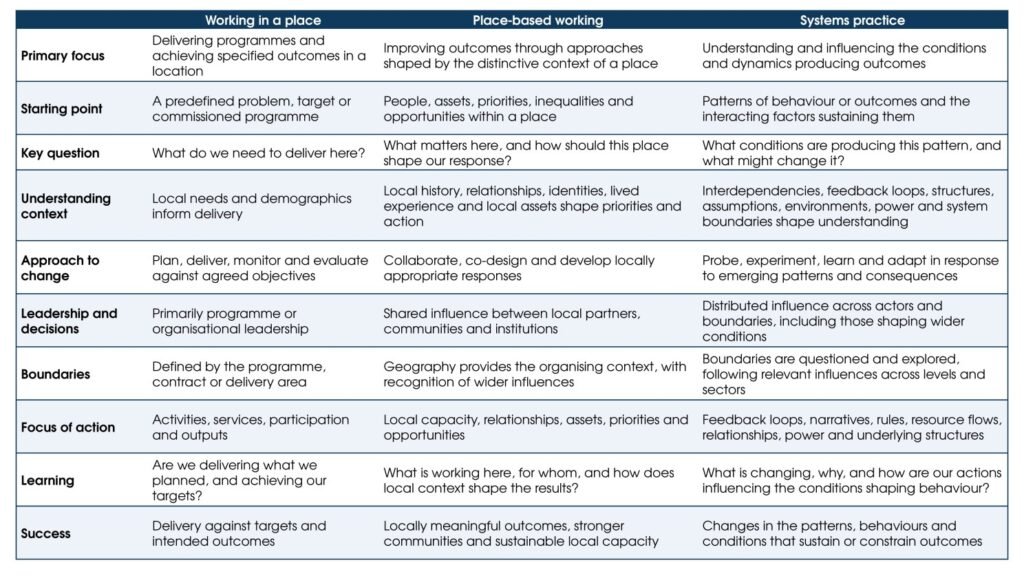
These three approaches can overlap, but they are not interchangeable.
Where the approaches meet, and where the differences matter
Many place based programmes already have an explicitly systemic ambition. The question is how reliably that ambition survives when we rub up against deep-rooted constraints like budgets, reporting requirements and everyday decisions. A place-based approach might sit inside those constraints, and a systems approach might look to understand and influence them.
Lets use an example to explore this a little further…
Imagine several organisations working together to increase physical activity in a neighbourhood. Maybe they share insight, coordinate provision and build relationships with residents. Useful place based work is happening there. But each organisation’s funding still depends on demonstrating its own participant numbers. Referring someone to another provider might be the right thing for that person, while weakening the referring organisation’s case for continued funding. In that context, collaboration in place does not, by itself, show that we are addressing the systemic conditions shaping our collective behaviour.
Our place based investment might reinforce the very patterns we hope to change.
Investing in “place” through traditional community investment approaches, for example, can potentially create a reinforcing feedback loop. Organisations that can demonstrate the most participation (particularly with a “target” audience) attract more funding, build more capacity and become better placed to demonstrate participation and secure the next investment. Where organisations compete for a limited funding pot, this can leave smaller community organisations progressively less able to secure resources or demonstrate their contribution. A funding process intended to reward success could gradually weaken the diversity of provision the place needs. That is a possibility to investigate, rather than a conclusion to assume; but it takes us beyond asking whether partners collaborate well. It asks what patterns their interactions are producing, and what keeps those patterns going.
A systems approach should influence what happens next not just be a discussion in a meeting. Perhaps partners reconsider how they recognise shared contributions. Perhaps commissioners change what they ask organisations to demonstrate. Perhaps they test a different arrangement on a small scale. And whilst none of those changes guarantees success, a systems approach probes and tests changes, challenges and explores assumptions, and learns from what happens next. There may be delays before effects become visible, or improvements in one part of the system might be accompanied by difficulties elsewhere.
The discipline is to try something with manageable risks, look for those wider effects, and use what emerges to decide what to strengthen, adjust or stop.
Learning is vital, and it should change what happens next
Learning matters because systems work can become remarkably comfortable with discussion. We can spend a long time exploring complexity without allowing it to actually impact any of our tangible decisions.
A systems map may help. So might a better conversation, learning more about systems leadership, or understanding the wide array of tools available. However, their value becomes clear when they inform our decisions, including what we change, what we continue, what we watch and what we deliberately choose not to do.
Working locally doesn’t mean the things we need to change are all local.
There is another reason to recognise the distinction between place and system: the boundary.
A neighbourhood can be a sensible focus for action without containing all the influences that matter. Employment practices, transport decisions, national policy and investment rules can shape local possibilities from well beyond the area in which we are funded to work.
If we overlook this, place based working can become the localisation of responsibility. Communities are encouraged to take ownership while important decisions remain elsewhere. We see this tension in our work all the time. Sometimes we dismiss it and might be found saying, “Let’s just focus on what we can do locally.” That’s not necessarily a mistake, but the nuance is worth exploring. Something I’ve been exploring and talking about for a while is the dance between national to local and local to national, and how learning and influence flow between the layers.
We have to recognise that choosing the boundary, geographical or otherwise, is an intervention in the system in and of itself. It defines scope, potentially limits imagination, and possibly gives us sufficient focus to avoid becoming overwhelmed. It also determines whose experiences we consider, which influences we investigate and what we treat as somebody else’s problem. Local leadership need connections to people who can act on those wider conditions. Those people, in turn, need to be willing to change their own practice in response to what communities reveal.
That doesn’t mean every rule should disappear or every decision should be devolved. Some constraints protect safety, fairness and public money. Local flexibility can improve responsiveness; it can also produce challenges that our governance structures can find difficult to cope with.
Systemic leadership requires judgement about what needs consistency, where discretion is useful, and how we notice when something isn’t working.
So before declaring that we already work systemically, we might ask ourselves some harder questions:
- Are we clearly distinguishing between place and system? Does our approach feel similar to what we’ve been doing for years, but now just centred on a smaller geographical footprint?
- How does our service delivery affect the wider system? Are we responding to immediate needs while also examining whether our approach changes, sustains or reinforces the conditions producing them?
- What feedback loops are sustaining the pattern we want to change? Where do our responses reinforce the problem, counteract one another or create dependence on continued intervention?
- Whose perspective defines the system we are working on? What becomes visible if residents, frontline workers or people currently excluded draw the boundary and describe the problem differently?
- Where might improvements in one part create difficulties elsewhere? Whose outcomes are improving, whose are worsening, and what falls outside our measures of success?
- What constraints are shaping behaviour, and where might there be leverage? Would changing a funding rule, an information flow or who can make a decision achieve more than adding another activity? What valuable protections could we disturb?
- How are we working with emergence and uncertainty? Are we testing different plausible approaches and allowing unexpected results to influence our direction, or delivering a predetermined plan with a learning log attached?
- What timescales are we paying attention to? Could delayed benefits make useful work look ineffective, or short-term gains conceal longer-term harm? What would persuade us to revise our explanation of what is happening?
These questions reach beyond the quality of our partnerships. They ask us to examine the dynamics of the situation, the limits of our understanding and the consequences of our own involvement.
They apply equally to practitioners, commissioners, funders and those of us who advise and facilitate. Familiarity with the language gives none of us a special exemption, nor should it give us comfort that we “know what we’re doing”. Place based working grounds us in people’s lives and the particular context in which change matters. Systems approaches help us explore connections, question assumptions and act with greater awareness of uncertainty and wider consequences.
Bringing them together requires systemic leadership: connecting across boundaries, sharing influence, making thoughtful changes and being prepared to revise our approach as we learn.
We need both “place” and “systems” thinking and approaches.
We need systems approaches practised in the context of place. And we need to judge them through the work and decisions they shape.
So, take a decision you are about to make. A commissioning brief. A funding renewal. A partnership priority. A measure of success. Ask what a systems perspective would lead you to question, whose understanding might unsettle your own, and what you might consequently do differently. There may be good reasons to retain the original decision. But if our systems thinking repeatedly leaves our priorities, assumptions and ways of working untouched (with the exception of focusing on a certain geography), we should be willing to question how deeply we are practising it.
“We’ve been doing this for years” can be the beginning of a valuable conversation. But doing something specifically in a targeted geographical place context, on the back of good community engagement, isn’t the same as working systemically. It isn’t bad, but it isn’t the same.
Voices from the Sector:
“There is rightly growing momentum around place based working, but I worry we’re hearing less about system change. If we’re serious about tackling inequalities, we need both. Working with communities is vital, but we must also challenge the leadership, policies, decisions and funding that shape those inequalities at local, regional and national levels. Otherwise, we risk asking local partnerships to change whilst the wider system stays the same.
We also need to simplify the language. Before taking on my current role, much of this terminology wouldn’t have meant anything to me. Now it feels normal, but that doesn’t mean it’s understood by everyone. Even ‘place based working’ means different things to different people. We need to be clearer about what we mean and what we want to change, otherwise we risk leaving people behind.”
Andy Taylor, CEO, Active Partnership National Organisation
“It’s fair to say that systemic, place-based working continues to be quite the journey for us at London Sport. It’s true that we previously “worked in place”, but what we’ve discovered is that really what that meant was finding very tailored local initiatives that suited the characteristics of a place.
It has involved our fantastic Place team working hard to collate local insights, build relationships and work with local partners closely to make sure initiatives worked in that place. However, the real leap with our current systemic place working, through the Sport England Place Expansion Programme, is actually a much more radical transformation of who is working with who, how various local players join up, and how resources are pooled; ultimately working in a different way.
That’s hard because working differently takes trust, and sometimes these are not new relationships and sometimes different levers and incentives pull us in different directions. It’s best to admit when things are hard and own the missteps we’ve made, holding on to the aims of the final prize – in our case serving those who need our support the most to live healthier, happier lives through physical activity.
It does feel like ‘place’ is back in fashion again. A sort of full circle moment for me, from working on “Total Place” in the late 2000s while I was at the Local Government Association. It’s great to be able to put some of those ideas into practice”.
Emily Robinson, CEO, London Sport
“We have all done it, picked up the latest jargon and used it without ever clarifying meanings. Our use of language is important to delivering change particularly in partnership settings so how often have we sat in partnership meetings with different professionals each using there own jargon. How do we find a shared way forward and build trusted relationships without common language and shared understanding. And how can we ever build relationships with communities when they haven’t a clue what we are talking about. Ken rightly challenges our understanding of two terms, place based working and system change. He suggests they are being used as interchangeable when in fact they mean very different things and goes on to explain the difference. I share much of his analysis and would recommend we all try to answer the questions he poses at the end. But I think there is a very serious point to his challenge. A place focus may help us better understand what communities are experiencing in terms of opportunities and barriers to becoming more active often referred to as understanding the context for change. But unless we go on and work actively to change how things work to create those opportunities and remove barriers, nothing will be different for those most inactive. Understanding place is the easy bit, changing how the system works is the hard bit. If we don’t properly separate the two concepts it will be too easy to accept the status quo and so let down those communities that need the change most.”
Martyn Allison, Active Wellbeing Leadership Network
“As I read your article what comes to mind is that often systems working comes from the top and down so often is working in the deficit to fill gaps and focusing on better experiences, better access, more personalised care as well as if possible, less resource intensive processes, while place working comes from the community and up and is far more strength based. I have made that quite binary for ease of understanding although it perhaps isn’t that binary in reality.
This pressure from the leaders of public and health services (big chunks of the established system), with the funds has to meet the strengths based work from the community. While we might want the systems work to be coproduced this is not always (rarely) done, consultation may happen but not co-production. This can then create different working methodologies that often get entangled together and where the slash between systems / place working does the heavy lifting perhaps. It therefore also makes me reflect about which makes most difference to communities as I think that systems mainly focus on, and kick in when things are going less well for individuals e.g. Crisis Resilience Fund, healthcare pathways, ASB work etc. While we all might recognise community can work with and prevent many of these problems there is also a need for professional support for them when they do happen. Place working needs to be much more about bringing what is strong in a community to the fore and uncovering individuals gifts and strengths and until the two methodologies start to align better maybe the two will continue to feel clunky.”
Jane Knowles, CEO, Somerset Active Sport Partnership
“Before Sport England’s Place Expansion programme, Active Norfolk was already working in a highly place-based way. What changed through our involvement with the programme was our understanding of systems: how change happens, what conditions influence outcomes, where influence sits, and how organisations collectively shape those outcomes. The biggest shift has been in how we think, collaborate and work with partners. Systems working has strengthened and evolved our place-based practice rather than replaced it.
One lesson we learned is that place-based activity alone is unlikely to shift systems unless those influencing policy, investment, governance and organisational behaviour are engaged from the outset – you can’t wait for the system to notice. Part of systems leadership is creating the conditions for these conversations early, helping leaders challenge assumptions, see different perspectives and build a shared understanding of why change is needed. Without that, great local work can struggle to influence the wider conditions that determine long-term outcomes.”
Rebecca Tuff, Head of Active Communities, Active Norfolk
“Place-based working is not new to Blackpool, but Move Together Blackpool has provided an opportunity to strengthen this approach and embed it more deeply across the system. Working closely with communities has helped us build relationships, understand local experiences and address health inequalities in ways that matter to people. At the same time, we have learned that sustainable change requires us to look beyond neighbourhoods and understand the wider systems that influence people’s opportunities to move. Policies, funding, organisational priorities and decision-making all play an important role in shaping what is possible at a local level.
Our experience shows that sustainable change comes not from delivering more activity, but from strengthening relationships, connecting local insight with strategic decision-making, and creating the conditions for movement to become everyone’s business. Through our Systems Leadership Programme and Community of Learning, we have brought together leaders from across Blackpool to build stronger connections and ensure movement is part of broader conversations about improving lives and places.
Move Together Blackpool will continue to challenge itself to understand whether we are addressing the root causes of inequality or simply responding to their consequences, remaining open to learning and adapting as we work towards a system that better supports those experiencing the greatest disadvantage.”
Laura Ivinson, Strategic Programme Lead – Move Together Blackpool
“Really enjoyed this – thank you. That slash between “place” and “system” has been bugging me for years too with the layers of culture, mindset and habitual thinking and the worst of compliance.
There’s a line from one of my great mentors at The Royal Mint Leighton James that I keep coming back to… if something can only happen once, you might put it down to human error. If it can happen again, it’s systemic – and if it’s systemic, the system can be built to stop it. Your physical activity example is exactly that. Nobody in that neighbourhood is behaving badly. The funding rules make referring someone on feel like shooting yourself in the foot… so it’ll keep happening, however lovely the partnership meetings are.
For me that’s where equity and reality come in. Equity asks who the current arrangement works for. Reality asks what’s actually happening on the ground, as opposed to what the strategy says is happening. If the small community groups are slowly being squeezed out, that’s the reality, whatever the slide deck says. I’d add one thing. Most of us plan forwards from where we are… what have we got, what can we tweak? Start instead from the big picture, from what we’re actually trying to achieve for people, and work backwards to today. Then the constraints show up as things to change rather than the walls of the room. And the most important word in all of this might be “so”. We’ve mapped the system… so? We’ve had a great conversation… so what are we doing differently on Monday? If there’s no good answer to “so…?”, I’m not sure we’re doing systems work yet!!!”
Peter Hall-Jones