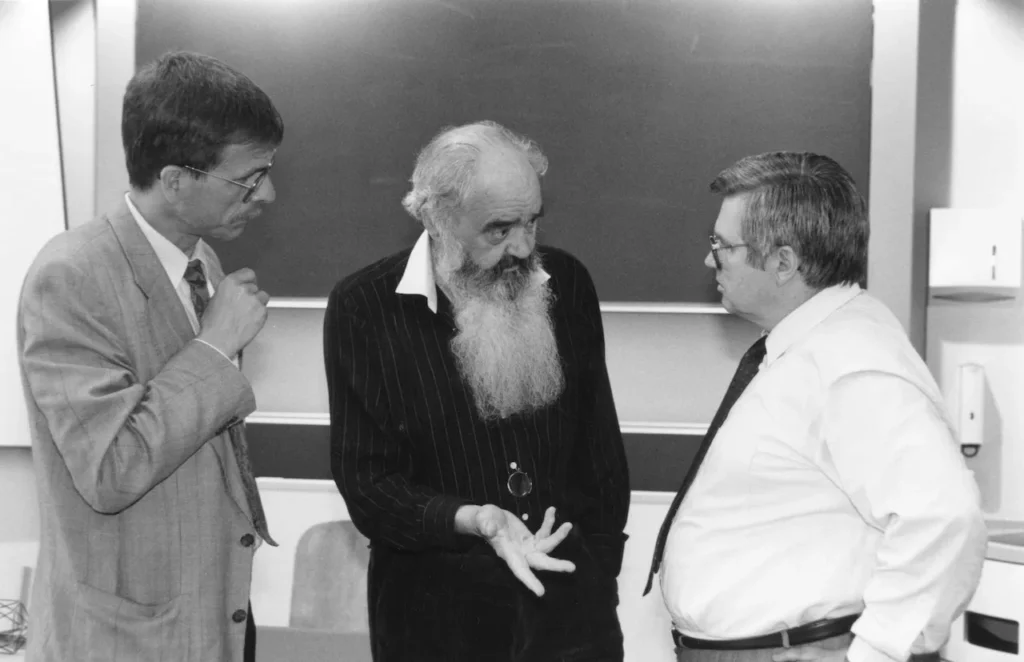
When people talk about systems thinking today, they rarely start with Stafford Beer.
They talk about complexity. Emergence. Networks. Adaptive leadership. Power. Equity. Learning systems. Place.
And yet, whether they realise it or not, Beer is still in the room.
His work didn’t just shape a moment in time. It laid foundations that modern systems thinkers have been building on, questioning, softening, and humanising ever since.
Understanding that lineage matters. Not for nostalgia, but because it helps us avoid repeating old mistakes in new language.
Beer’s core gift: viability in complexity
Beer’s central question was brutally practical: How does a system survive in an environment it cannot fully control?
That question shows up everywhere now:
- In climate adaptation
- In public service reform
- In health and wellbeing systems
- In place-based working
Beer’s answer was viability: systems must balance autonomy and coherence, local action and system-wide learning, freedom and constraint.
That framing still underpins modern thinking – even where the language has changed.
From control to complexity: where others picked it up
Take Dave Snowden.
Snowden’s Cynefin Framework pushed systems thinking firmly away from prediction and towards sense -making. His work makes explicit what Beer implied: in complex systems, you don’t analyse first and act later – you probe, sense, and respond.
Where Beer focused on organisational viability, Snowden focused on decision-making under uncertainty. Same roots. Different emphasis.
Both reject best practice. Both esteem feedback. Both make leaders uncomfortable in exactly the right way.
Learning systems, not just surviving ones
Beer wanted systems to survive.
More recent thinkers have pushed the question further: can systems learn, and who gets to decide what learning looks like?
This is where Peter Senge enters the conversation. His work on learning organisations added something Beer largely left implicit: collective reflection.
Mental models. Shared vision. Team learning.
In today’s systems work, this shows up as:
- Learning loops, not just feedback loops
- Reflection built into delivery
- Permission to adapt without seeking approval
Viability without learning leads to stagnation. Modern systems thinkers made that visible.
From systems to people: the human turn
One of the strongest critiques of early systems thinking – including Beer – is that it could feel abstract. Elegant. Distant from lived experience.
Thinkers like Margaret Wheatley changed that tone. Wheatley brought systems thinking into the realm of relationships, meaning, and trust.
She reminded leaders that systems don’t change because structures shift, but because people do.
This reframing matters deeply in place-based work. You can redesign governance endlessly. Without trust, nothing moves.
Power, participation, and practice
More recently, systems thinking has been pulled firmly into questions of power.
Donella Meadows famously articulated leverage points, but what’s often overlooked is her insistence that paradigms matter more than parameters.
That insight has been taken up by practitioners focused on: equity, participation, community-led change and decolonising systems practice
Modern systems leadership doesn’t just ask “how does the system work?”It asks “who does it work for, and who gets to shape it?”
That’s a shift Beer didn’t fully articulate, but one his work made possible.
Networks, not hierarchies
Beer challenged rigid hierarchies. Modern thinkers went further – towards networks.
From social network analysis to distributed leadership models, the focus has shifted from designing control to cultivating connection.
In practice, this shows up as:
- Less emphasis on single accountable bodies
- More emphasis on stewardship roles
- Attention to informal influence, not just formal authority
This is where systems thinking meets real-world place leadership: messy, relational, and adaptive.
So where does Miova sit in this lineage?
We see our work as sitting between generations of thinking.
Grounded enough to know where ideas come from. Practical enough to know when theory gets in the way.
Beer gives us structural insight. Snowden helps us act under uncertainty. Senge and Wheatley keep us human. Meadows keeps us honest about power and paradigms.
But none of them do the work for us.
That happens in rooms with leaders who are trying to make sense of complexity while still delivering tomorrow. In places where progress depends less on perfect models and more on better judgement, shared courage, and small acts of redistribution.
From legacy to living practice
Systems thinking didn’t replace Beer. It grew from him.
And today, the task isn’t to defend his ideas, or discard them, but to keep evolving them in response to the realities we now face.
That’s the work.
Not reverence.
Not reinvention for its own sake.
But learning, in public, with purpose.
And a quiet refusal to pretend that complexity can ever be solved, only lived with more wisely.
This article draws on a lineage of systems thinkers whose work reflects the evolution of the field:
- Stafford Beer
- Cybernetics and Management (1959)
- Brain of the Firm (1972)
- The Heart of Enterprise (1979)
- Dave Snowden
- The Cynefin Framework and associated writing on complexity, sense-making, and adaptive action
- Peter Senge
- The Fifth Discipline (1990) — learning organisations, mental models, and shared vision
- Margaret Wheatley
- Leadership and the New Science (1992)
- Later writing on leadership, meaning, and relational trust
- Donella Meadows
- Thinking in Systems: A Primer (2008)
- Influences from:
- Network theory and social network analysis
- Adaptive leadership
- Place-based and whole-system change practice
Together, these works reflect the shift from early systems design toward a more human, relational, power-aware, and practice-oriented approach to systems leadership.