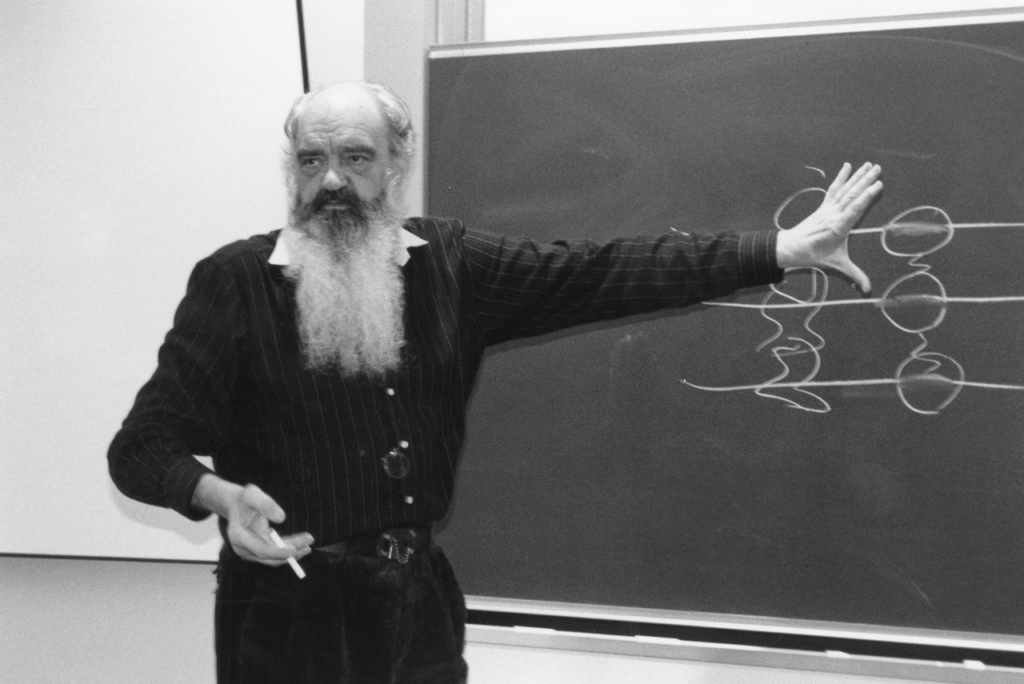
This year marks 100 years since the birth of Stafford Beer, a figure whose ideas are the quiet foundation of much of what we now call systems leadership, whole-system change, and place-based working.
Beer never set out to be fashionable. He wasn’t interested in slogans, toolkits, or neat diagrams you could laminate and forget. He was interested in one thing: how real systems actually survive in the real world.
That makes him really relevant right now.
At Miova, we spend most of our time working with leaders who already know that the old playbook doesn’t really work anymore. Targets multiply. Governance thickens. Strategies look polished, but progress feels stubbornly slow. Beer was diagnosing that problem decades ago.
Stop treating organisations (or ecosystems!) like machines
Beer’s starting point was simple but uncomfortable: most organisations are designed as if they are machines – predictable, controllable, optimisable. But they aren’t. They are living systems.
Living systems adapt. They respond to feedback. They survive by sensing what’s changing around them and adjusting their behaviour accordingly. When you try to over-control them, they don’t become efficient, they become brittle.
This is why Beer was so critical of top-down command-and-control. Not for ideological reasons, but for practical ones. It simply doesn’t work in complex environments.
Maybe this sounds familiar to you and your organisation?
The Viable System Model (and why it still trips people up)
Beer’s most well-known contribution is the Viable System Model (VSM). It’s often described as a model of organisational design, but that undersells it.
At its heart, VSM is a test:
Does this system have what it needs to survive in a changing environment?
It argues that any viable system (whether a team, an organisation, or a whole place) needs a balance between:
- Doing the work
- Coordinating activity
- Managing resources
- Looking outward and forward
- Holding identity, purpose, and values
Here’s the bit that still makes people uncomfortable: these functions must exist at every level of the system.
You can’t centralise intelligence and expect local actors to adapt.
You can’t push responsibility downwards while pulling control upwards.
You can’t demand innovation while punishing deviation.
We see this tension constantly in public systems.
Where this shows up in our work
We rarely walk into a place and say, “Let’s apply the Viable System Model.” That’s not our style, and it’s rarely helpful.
But Beer’s thinking shows up in the questions we ask: Where are decisions actually being made, and where are they just being reported? What feedback loops exist between communities, services, and strategy? Who is allowed to adapt, and who is expected to comply? Where has coordination quietly turned into control?
In physical activity systems, for example, we often see incredible energy at the delivery level: local leaders, volunteers, practitioners doing the right things for the right reasons, while the wider system struggles to keep up with them.
Beer would recognise that instantly. The system isn’t failing because people aren’t trying hard enough. It’s failing because the conditions for viability aren’t in place.
Where we respectfully challenge Beer
Marking 100 years is also a chance to reflect and re-evaluate.
Beer’s work can sometimes feel over-confident in structure. The Viable System Model is elegant and powerful, but in the wrong hands, can become another blueprint imposed on a living system rather than explored with it.
Two tensions matter for us:
First, lived experience.
Beer focused heavily on organisational viability, but less explicitly on power, inequality, and whose voices are systematically excluded. In place-based work, viability for the system does not always mean viability for everyone within it. We have to hold that tension consciously.
Second, practice before purity.
VSM can be interpreted as something to “get right.” Our experience tells us that systems don’t become healthier by perfect design, but by better conversations, clearer relationships, and small shifts in decision-making authority.
In other words: Beer gives us a lens, not a template.
One line we return to again and again
“The purpose of a system is what it does.”
Not what the strategy says, nor what the vision slide promises. It is what it actually produces, day after day.
This idea cuts through performative change and forces an honest conversation:
If this is the outcome we’re getting, what is the system currently optimised to do?
Why Beer still matters at 100
Beer was writing before digital dashboards, before systems maps became fashionable, before “complexity” entered everyday leadership language. Yet his work feels increasingly relevant because complexity hasn’t gone away, it’s intensified.
His legacy isn’t a model to be copied. It’s a mindset: design for adaptation, not control; trust feedback more than hierarchy; build systems that help people do the right thing, rather than forcing them to do things right.
At Miova, we see our role as standing in that tradition – aware of the intellectual roots but focused firmly on application. Helping leaders see their system more clearly, act more wisely within it, and create the conditions where meaningful change can actually take hold.
A hundred years on, Beer’s challenge still stands.
The question for today’s system leaders isn’t whether they understand complexity.
It’s whether their system is truly designed to live with it.
If you want to go back to Beer himself
For those who want to explore Beer’s thinking directly, these are his most influential works:
- Cybernetics and Management (1959)
- Brain of the Firm (1972)
- The Heart of Enterprise (1979)
- Diagnosing the System for Organisations (1985)
- Designing Freedom (1974)
They’re challenging, occasionally idiosyncratic, and still deeply provocative, especially when read alongside today’s lived reality of public and place-based systems.