
There are few things as frustrating (and entertaining) as watching a group of people confidently banish the wrong person from a Scottish castle.
From the couch in my living room, it seems really obvious. Because we can see exactly who is lying, how they’re doing it, which relationships they’re relying on, who’s being manipulated and who is about to make a disastrous (and hilarious) bad decision. We can see it all, and yet every Wednesday and Thursday evening we’ve watched another faithful making a speech in front of the round table, revealing their identity and leaving the castle. And behind them, there is a group of people either stressed to the max and wondering how they managed to get it so wrong or relieved they made it through again.
But it does make me wonder how well I, or any of the rest of us, would do if we were sitting around that round table…
Because even though we unfortunately don’t often get the dramatic music or Caludia Winkleman’s increasingly brilliant wardrobe in our workplaces and systems, we do see that just like in the Traitors, the way people behave is influenced by the systems they’re part of.
So, what could a castle full of secrets (and the people trying to figure them out) teach us about systems thinking?
The Round Table: Don’t Even Believe Yourself.
One of the things about Traitors that always makes me and my family laugh is how quickly absolutely anything can turn into cold, hard evidence.
If someone is quiet, then clearly they’re hiding something. If someone’s talking too much then obviously, they’re trying to control the conversation.
If someone gets emotional when they’re being accused, that reaction is too dramatic so of course it’s an act. If someone doesn’t get an emotional at all, well, a faithful would care more.
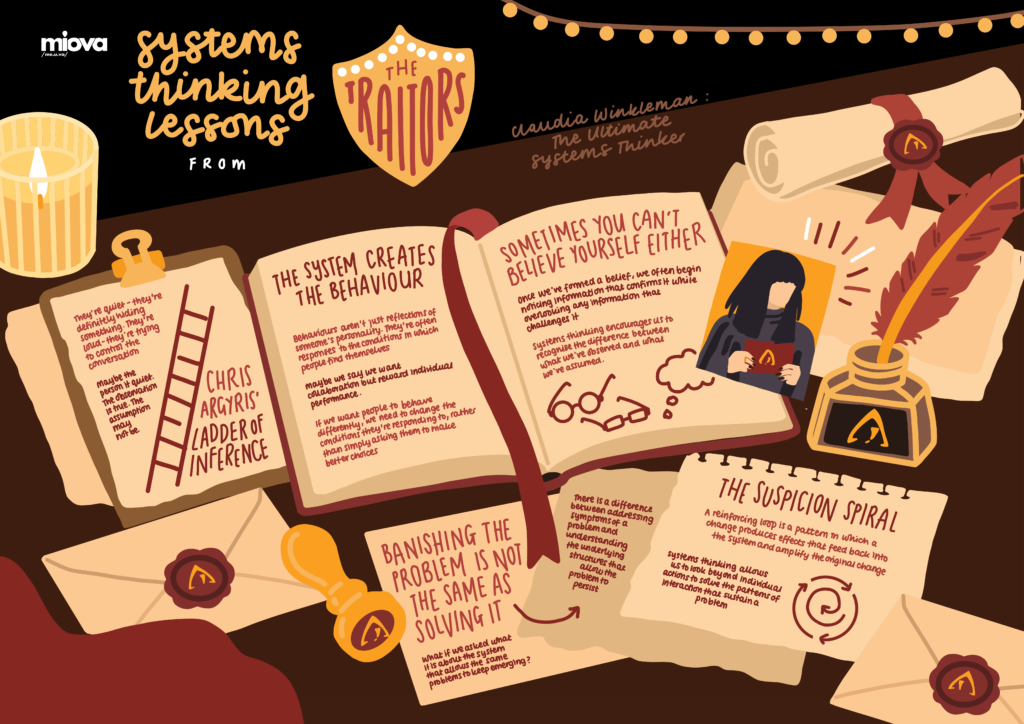
This is where we can introduce something called the ‘Ladder of Inference’ which is a concept generally attributed to an organisational psychologist named Chris Argyris.
The Ladder of Inference describes how we move from observing something to interpreting it, making assumptions, drawing conclusions, forming beliefs and eventually taking action. We often climb this ladder so quickly that we don’t even realise we’ve done it.
We see this both in real life and in the Traitors. Imagine a contestant on The Traitors notices that someone hasn’t contributed much to a conversation. That’s the observation. They might think the silence is discomfort, assume the person is worried about revealing something, and decide that they’re probably a Traitor and so they’re going to vote for them. By the time they get to the round table, what started as an observation has become something they’re convinced is true. But what if the person was just tired? Or overwhelmed? Or naturally quieter in a group?
The problem isn’t necessarily that the observation was wrong. Maybe that person isn’t contributing much to the discussion. The problem is that the meaning attached to it was never tested.
And once we’ve formed a belief, we often begin noticing information that confirms it while overlooking any information that challenges it.
How often do we do exactly the same thing in our workplaces?
A colleague doesn’t respond to an email, and so we decide they’re disengaged. Someone questions our idea, and we assume they’re resistant to change. A community doesn’t engage with a service, and we think or even say out loud that they aren’t interested.
Systems thinking encourages us to recognise the difference between what we’ve actually observed and what we’ve assumed.
The next time we’re absolutely convinced we know why someone is behaving a certain way, perhaps we should ask ourselves whether we’re working with evidence or simply a very convincing story we’ve told ourselves.
Trust No One. The System Creates the Behaviour
One of the things I imagine would be really tricky in the Traitors castle (apart from wanting to hang out with Claudia all the time) is that you’re in a battle between trying to build relationships but also being given all kinds of reasons to question those relationships.
You have to work together to find traitors, but there’s no way to be sure the person you’re trusting isn’t a traitor themself.
And at the same time, the traitors are being praised and rewarded for being convincing and getting you to trust them.
That kind of environment means that suspicion isn’t only understandable, it’s necessary for survival.
I think the lesson this teaches us about systems is that the structure of a system influences how people behave within that system.
The game (or system) creates behaviours aren’t simply reflections of individual personalities. They’re also responses to the conditions in which people find themselves.
Take someone who becomes secretive or defensive at the round table. We might interpret that as a personality trait, but maybe they’re just responding to an environment where saying the wrong thing could mean they get banished and have to leave a really exciting experience behind.
Maybe this can help us think about what happens when we create similar conditions in organisations.
We might say we want collaboration but keep rewarding individual performance. We might encourage people to be honest about mistakes but also create a culture where mistakes are punished. Or we might ask teams to share information without trying to change structures that make information difficult to access.
And then we wonder why people compete, conceal problems or work in silos.
Of course, this doesn’t mean individuals have no responsibility for their actions, they do. But it does mean we should be careful about assuming that behaviour can be understood without context.
If we want people to behave differently, we need to change the conditions they’re responding to, rather than simply asking them to make better choices.
Everyone’s a Suspect – The Suspicion Spiral
There’s another interesting pattern that plays out around the round table too.
You might have noticed that when someone is suspicious of another contestant, they point this out to a few other people, and together they watch this person more closely. All of a sudden, things they might never have noticed otherwise become evidence and the accused contestant notices the growing suspicion and inevitably starts behaving differently which then turns into further proof that they can’t be trusted.
The suspicion that created the behaviour becomes the reason to be suspicious.
In systems thinking, we might describe this as a reinforcing feedback loop.
A reinforcing loop is a pattern in which a change produces effects that feed back into the system and amplify the original change.
In this case, the loop might look something like this:
More suspicion leads to closer scrutiny. Closer scrutiny leads to more ambiguous behaviours being interpreted negatively. This increases the pressure on the accused, potentially changing their behaviour and creating even more suspicion.
This is fascinating to me because while all of this is going on and the loop goes round and round, the person at the centre might be a faithful after all.
We see similar patterns in organisations.
Imagine a manager starts to worry that a team member isn’t performing well. One option could be that they increase their oversight, they start checking every decision and asking for more frequent updates. This could mean the team member begins to feel mistrusted, loses confidence and becomes less willing to take initiative. The manager sees this as further evidence that the employee needs close supervision, so they increase their oversight again.
Neither person necessarily intends to create this situation, but their responses to one another are reinforcing a pattern that becomes increasingly difficult to escape.
Systems thinking helps us look beyond individual actions to understand the patterns of interaction that sustain a problem.
Sometimes, the most useful question isn’t simply “Who’s causing this?” but “How might our responses be contributing to what happens next?”
Banishing the Problem: Are We Actually Changing Anything?
Each evening, the faithful gather around the round table with one very clear goal, to identify a Traitor and banish them (and it makes me laugh that every day they tell the camera this, ‘my goal today is to find a traitor and banish them’… well, yes, what else have you been doing this whole time if that’s your goal today?…)
But when they get it right, and achieve their goal, there’s a tangible sense of achievement. The group celebrates, everyone congratulates themselves on their detective skills, (and although it usually doesn’t last long,) it feels as though they’ve made real progress.
But there’s an interesting twist. The game also allows traitors to recruit someone to join them.
So, even though the faithful might successfully remove a traitor, the system can sometimes produce another one. This is where I think The Traitors offers one of its most interesting lessons about systemic change.
We often approach problems by identifying the people or things we believe are responsible and trying to remove, replace or correct them. But if the conditions that contributed to the problem stay the same, we shouldn’t be surprised when similar problems begin to emerge again.
Systems thinkers often talk about the difference between addressing the symptoms of a problem and understanding the underlying structures that allow it to persist.
The challenge is that symptoms are usually much easier to see.
We might be able to identify an individual who isn’t collaborating, but it’s harder to recognise what the competing priorities are, what performance measures are affecting things, what relationships and organisational expectations are that might be discouraging collaboration in the first place.
Maybe we can introduce a shiny new initiative to try to improve this. But it’s harder to go back to the root and question whether existing policies and ways of working are recreating the conditions that make that outcome difficult to achieve.
In the Traitors, the faithful don’t have the power to redesign the game. They have no choice but to play by the rules they are given and do their best to identify traitors and win the money.
But outside the castle, we often have more opportunity to question and shape the rules themselves. And that might even be where the greatest opportunities for change are.
Rather than asking only how we can get better at identifying and removing problems, what if we also asked what it is about the system that allows those problems to keep emerging?
I think watching the Traitors is a fantastic way to spend an evening but it’s also a good reminder of how difficult it is to make sense of a situation when we don’t have the whole picture.
The contestants are working with limited information, trying to figure out what someone else’s behaviour means based on assumptions and rules they didn’t design. But they’re remarkably confident in the conclusions they come to.
That might not be that different from the rest of us.
In our organisations, communities and everyday lives, we’re continually trying to make decisions within complex systems that we can never fully understand.
We form assumptions, respond to incentives, influence one another and sometimes unintentionally reinforce the very problems we’re trying to solve.
Systems thinking doesn’t give us the ability to see everything or guarantee that we’ll always make the right decisions.
But it does encourage us to become more curious about what we might be missing. To question our assumptions before treating them as facts. To consider how the conditions around us influence behaviour. To recognise the patterns we’re part of. And to look beyond the most visible symptoms of a problem.
Because finding the Traitor might win you the game – if you’re lucky – but understanding the system might help us change what happens beyond the castle.
And even though it’s hard to beat, that might even be better than Richard E. Grant immediately exposing himself as a traitor.
