
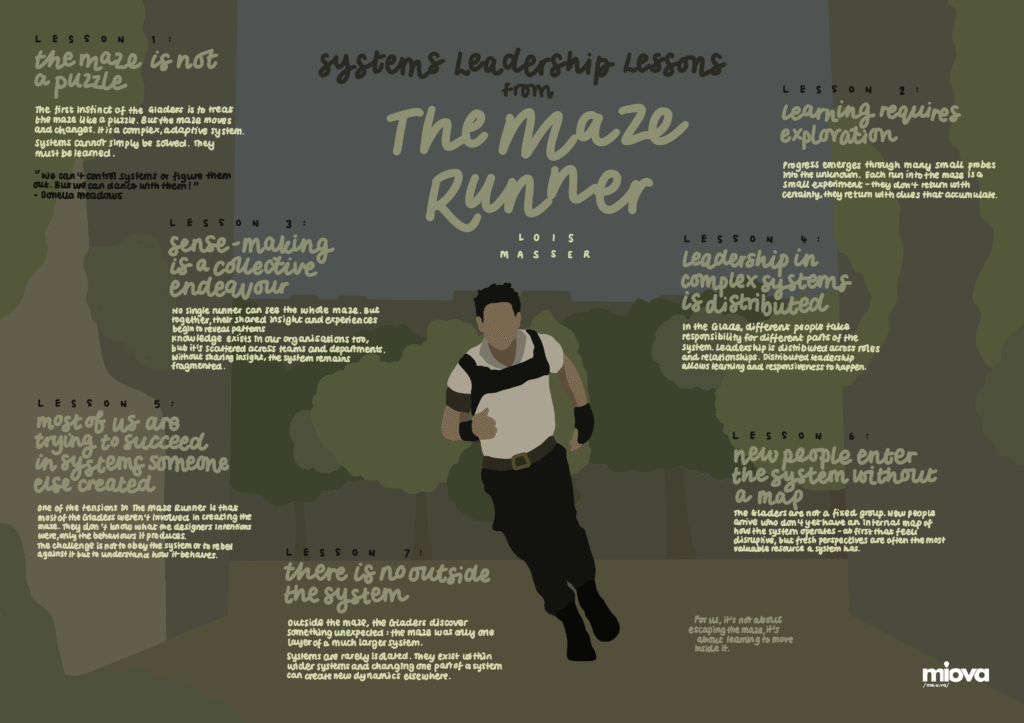
On the surface, it’s a dystopian adventure, The Maze Runner begins with a group of teenagers waking up in a place called the Glade: a clearing surrounded by towering stone walls. Each morning the walls open, revealing an enormous maze that shifts and changes every day. Thomas arrives there with no memory of his past. He doesn’t know where he is. He doesn’t know who built the maze. He doesn’t even know who he was before this.
What he des know is that the maze he’s living in the middle of changes constantly, and his escape and survival depends on understanding it. Beyond the action and mystery, the story offers a surprisingly good metaphor for life inside complex systems.
Most of us spend our working lives inside systems we didn’t design. Organisations, institutions, strategies and incentives already exist when we arrive. Structures were built by people responding to pressures that may no longer exist. And like the Gladers, we try to make sense of it.
Lesson 1: The Maze is Not a Puzzle
The Gladers’ first instinct is to treat the maze like a puzzle. If they can gather enough information, map enough routes and analyse enough patterns, the answer will eventually reveal itself. But the maze refuses to behave like a puzzle. It shifts, routes change, new dangers appear and what worked yesterday doesn’t necessarily work today.
In other words, the maze behaves less like a simple riddle and more like a complex adaptive system.
Complex systems evolve and respond to what happens inside them. Systems thinker Donella Meadows captured this beautifully when she wrote: “We can’t control systems or figure them out. But we can dance with them.” – Donella Meadows, Thinking in Systems
The Gladers eventually realise that the maze cannot simply be “solved”. Instead, it has to be learned.
Lesson 2: Learning Requires Exploration
Every day, the Gladers send runners into the maze. The runners are brave, fast and willing to take risks – exploring the unknown. But their role in the system is about more than heroism. They are how the community learns.
Each run is a small experiment. Runners test routes, notice changes and bring back fragments of information. They don’t return with certainty; they return with clues. But over time, those clues accumulate.
In complex environments, progress rarely comes from one person dramatically discovering the answer on an individual occasion. It emerges through many small probes into the unknown. This kind of exploration can feel uncomfortable. It involves uncertainty and the possibility of failure. But without it, systems struggle to adapt.
In organisations, runners might look like pilot teams, innovators or frontline staff testing new approaches in the real world rather than waiting for perfect certainty. Learning requires exploration and so systems need the runners – the explorers.
Lesson 3: Sense-Making is a Collective Endeavour
The runners return with information. But information alone doesn’t create understanding.
In the Glade, the maps drawn by runners are stored together in a place called the Map Room. Over time, the room fills with sketches and fragments of the maze’s changing layout. No single runner can see the whole maze. But as they spend time together in the Map Room, their shared insight and experiences begin to reveal patterns. The Map Room becomes the Gladers’ shared intelligence.
Systems thinkers often describe this process as collective sense-making. Complex systems are too large and dynamic for any one person to fully understand. Insight emerges when experiences are shared and interpreted together. As Russell Ackoff observed: “A system is never the sum of its parts; it’s the product of their interactions.” – Russell L. Ackoff
Many organisations struggle with this. Knowledge exists, but it’s scattered across teams and departments. Without spaces where insights can be shared and interpreted together, the system remains fragmented. The Map Room works because it gives the Gladers somewhere to think together.
Lesson 4: Leadership in Complex Systems is Distributed
Another interesting feature of life in the Glade is how leadership operates. Although some characters hold authority, leadership is not concentrated in one person. Different individuals take responsibility for different parts of the system.
Some provide stability and governance.
Some coordinate the community.
Some explore the maze.
Others keep the practical work of the Glade running.
Leadership is distributed across roles and relationships. Complex systems rarely respond well to centralised control. When knowledge and decision-making are concentrated in one place, systems lose their ability to adapt. Distributed leadership allows learning and responsiveness to happen across the network rather than through a single authority.
It recognises an important reality: no individual can hold the whole system in their hands.
Lesson 5: Most of Us are Trying to Succeed in Systems Someone Else Created
One of the deeper tensions in The Maze Runner is that most of the Gladers weren’t involved in creating the maze. They are living inside a system designed by someone else. They don’t know the designers’ intentions or the rules that shaped it. They only know the behaviours it produces: shifting walls, dangerous creatures and unpredictable patterns.
Many real-world systems feel similar. Policies, incentives and structures created years earlier still shape behaviour today, even when the original reasons have faded. In situations like this, the challenge is not simply to obey the system or rebel against it. The challenge is to understand how it behaves.
Peter Senge describes systems thinking as: “A discipline for seeing wholes.” – Peter Senge, The Fifth Discipline
Instead of focusing only on individual events, systems thinking encourages us to look at patterns, relationships and structures. Learning how the system behaves becomes the first step toward changing it.
Lesson 6: New People Enter the System Without the Map
Another detail in The Maze Runner is easy to overlook: the Gladers are not a fixed group. Every so often, a new person arrives in the Glade, sent up in the mysterious metal box from the world below.
Like Thomas, they arrive with no memory of their past and very little understanding of how things work. For the existing Gladers, the maze may already feel familiar. They know the routines, the roles and the rules that keep the community functioning. Over time they have built an internal map of how the system operates.
But new arrivals don’t have that map. They ask questions others stopped asking. They notice things that long-time residents have learned to accept. What feels obvious to some feels confusing to them.
This dynamic appears in many organisations and public systems. People arrive into environments where habits, assumptions and ways of working are already deeply embedded. Those who have been there longer often carry invisible knowledge about how the system behaves.
Newcomers don’t. At first, that can feel disruptive. Questions slow things down and established routines are challenged. But fresh perspectives are often one of the most valuable resources a system has.
New people notice what others have stopped seeing.
In complex systems, renewal often comes from this tension between experience and fresh perspective. The challenge is not simply to teach newcomers how things work, but to remain curious about what their questions might reveal.
Because sometimes the most useful insight comes from the person who has just arrived in the maze and isn’t yet convinced the walls have to be where they are.
Lesson 7: There is No Outside the System
One of the most striking moments in the story comes when the characters believe they have finally escaped the maze. The boundary that defined their world is broken. But instead of freedom, they discover something unexpected: the maze was only one layer of a much larger system.
Systems thinkers often highlight this reality. Systems are rarely isolated. They exist within wider systems. Solving one problem often reveals another layer of complexity. Improving one part of a system can create new dynamics elsewhere. In that sense, there is rarely a clean “outside”. There is only a wider system waiting to be understood.
Closing reflection
Perhaps the most important lesson we can learn from The Maze Runner is not about escaping the maze at all. It’s about how people learn to move within it.
The Gladers survive because they experiment, share information, challenge assumptions and adapt as they learn more about the system around them. They create space for exploration, build structures for collective thinking and distribute leadership. And gradually, their understanding grows.
That process – learning together in the face of uncertainty – sits at the heart of systems thinking.
The maze may never become fully predictable. But through curiosity, collaboration and experimentation, people can still find their way forward. And in complex systems, that may be the closest thing to a solution there is.
