
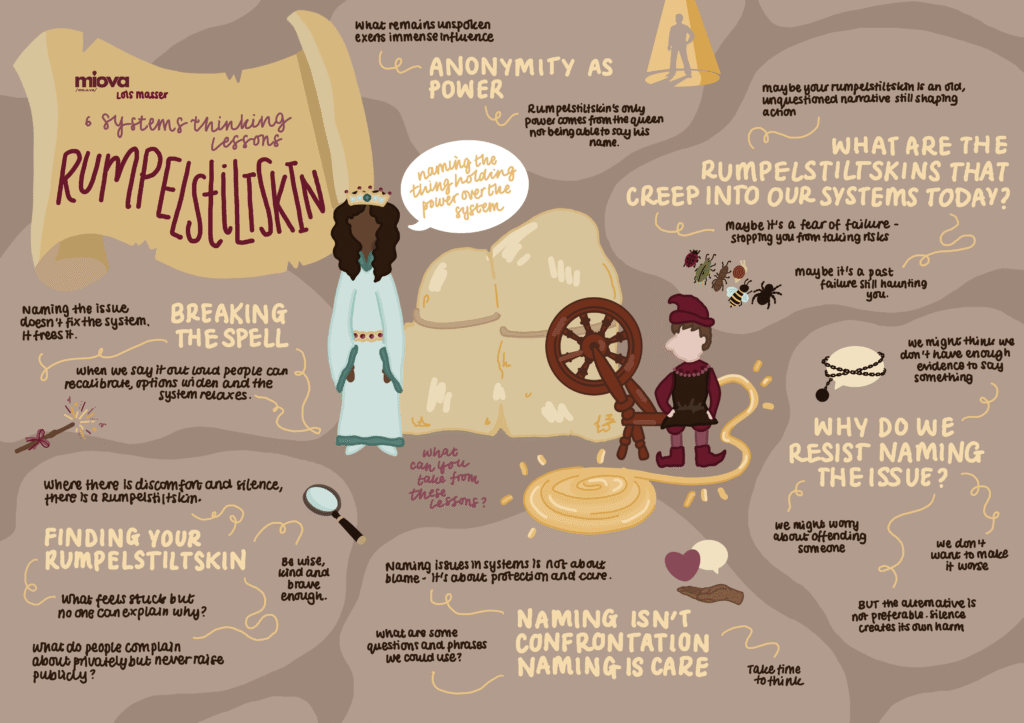
Naming the thing holding power over the system
Much of Miova’s work is about helping systems see themselves more clearly. And sometimes the biggest shift comes from naming the thing everyone has been tiptoeing around.
We’ve heard the fairy tale of Rumpelstiltskin – the miller’s daughter who can’t actually turn straw into gold for the king. And the little man who helps her… so long as she gives up her firstborn child – unless, of course, she can work out and speak his name.
Growing up, I could never understand this ending. Why is this the challenge he suggests? Was he just really proud of his unusual name? Or did he enjoy teasing her with something so silly?
As strange as it might seem, the ending teaches us something important about the power of naming: freedom emerges when we name the things that hold power over us. Especially in systems.
“When you name a thing, you bring it into existence as a distinct entity within a system, and only then can you start to understand its relationships and dynamics.” – Derek and Laura Cabrera (on DSRP Theory)
Anonymity as power
In the fairytale, Rumpelstiltskin’s power doesn’t really come from his magic. It comes from his anonymity. While he remains anonymous, he can dictate as he pleases, define the terms of any bargain, and maintain control over the situation.
Systems behave in exactly the same way. What remains unspoken – power dynamics, unhelpful habits, legacy stories, structural fears – exerts immense influence.
What we refuse to name ends up quietly running the system.
The spell can only break when someone has the courage to speak the truth.
“The most important interventions are often the simplest ones. It starts with bringing hidden assumptions into the open.” – Peter Senge (The Fifth Discipline)
What are the Rumpelstiltskins that creep into our systems today?
Sometimes your Rumpelstiltskin is a past failure still haunting you – you just couldn’t turn the straw into gold. Maybe your last attempt at collaborating with a partner didn’t go to plan. Maybe you’ve already tried putting out a physical activity strategy and it didn’t seem to make any difference. So you don’t want to revisit those options.
But no one names that memory, and so the system flinches every time you say ‘collaboration’ or ‘strategy’.
Sometimes your Rumpelstiltskin is the unquestioned narrative: ‘residents are disengaged’, ‘the council moves too slowly’, ‘we’re the only ones who really care about this’ or the system’s favourite story – ‘it’s always been like this’.
The narratives we let exist unchallenged are often old stories that no longer reflect reality but continue to shape action.
Sometimes your Rumpelstiltskin is a fear of future failure – your well-intentioned desire to ‘get things right’ stops you taking risks, which frustrates your team who are ready to dive right in. But you don’t communicate that fear, so they experience only the brakes, not the care behind them.
Why do we resist naming the issue?
There are lots of good reasons why we resist naming the Rumpelstiltskin. It might be that we don’t want to offend anyone or that we don’t want to create conflict. We might worry that naming the issue will make it worse or that we don’t have enough evidence to speak up. We might even fear that speaking up would be overstepping.
But the alternative is not preferable. Silence creates its own kind of harm, and when the truth stays in the shadows, the shadows begin to run the system.
Naming isn’t confrontation, naming is care.
The miller’s daughter’s goal in naming Rumpelstiltskin wasn’t to hurt him; it was to protect her child. In the same way, naming issues in systems is not about blame – it’s about protection and care. It’s a way of nurturing the health of the system rather than letting hidden forces quietly shape it.
How can we lead in a way that addresses these issues in the system?
Naming sounds like:
- “I’m noticing that we’re circling around purpose – can we pause to discuss it openly to make sure we’re aligned?”
- “I think the problem we might be facing is a fear of being blamed, is there a reason we might feel that way?”
- “We often make that comment about our local council, do we think it’s still true? Is it helpful to us?”
- “What external pressures are shaping what we’re doing right now?”
The questions you need to ask might not be immediately obvious to you. The miller’s daughter needed 3 days to discover the name. You might also need to need to intentionally set aside some time to consider the issues you might be facing before you can name them.
Finding your Rumpelstiltskin
“You just have to work at it, and in the process of making the complexity of the system visible, of naming its elements and interconnections, you often find the leverage point.” – Donella Meadows (Thinking in Systems)
You could ask yourself the following questions:
- What do people complain about privately but never raise publicly?
- What topic changes the energy in the room?
- What feels stuck, but no one can explain why?
- What behaviour repeats even though everyone hates it?
- What’s the story you often hear the system tell about itself that no longer feels accurate?
Where there is discomfort and silence, there is a Rumpelstiltskin.
Be wise enough to consider the issues you’re facing, kind enough to reveal the truth and brave enough to accept how it lands.
Breaking the spell
When the miller’s daughter, now a queen, learns Rumpelstiltskin’s name she says it out loud with a mix of fear, strength, determination and relief. That’s what naming in systems feels like: a release. Because naming the issue doesn’t fix the system. It frees it.
When we say it out loud people can recalibrate, relationships rebalance, options widen and the system relaxes. And sometimes the Rumpelstiltskin disappears in a puff of smoke, because its power was never real to begin with.
Naming the issue doesn’t fix the system, but it frees it.
This is why we do what we do at Miova – gently helping systems understand themselves so they can move forward with clarity and confidence.
