
What Monsters, Inc. Teaches Us About the Purpose of a System
When people think of Monsters, Inc., they maybe remember the colourful monsters or the endless rows of magical doors or the unlikely friendship between Sulley and Boo. Released in 2001 by Pixar, the story follows monsters Sulley and Mike, who work at the largest energy company in Monstropolis. Their job is simple: enter the bedrooms of human children and collect their screams, which are used to power the city. Sulley is the company’s top ‘scarer’, respected by everyone around him for his ability to frighten children.
But everything changes when a little girl named Boo accidentally enters the monster world. As Sulley gets to know her, he begins to question something that everyone else accepts without hesitation.
And in doing so, he challenges the system.
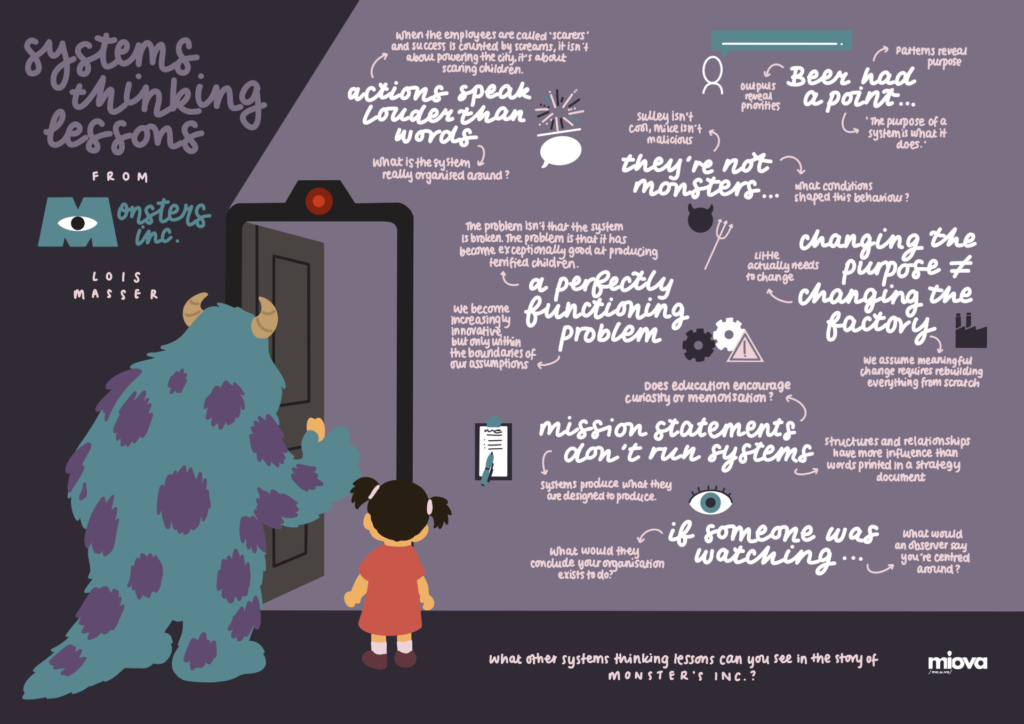
Actions Speak Louder Than Words
Imagine someone who had never seen Monsters, Inc. before walked into the factory halfway through the film. If you asked them what the organisation existed to do, what do you think they’d say? Most people would probably answer: “To scare children.”
Of course, if you asked the organisation itself, you’d get a different answer. Its purpose, they’d tell you, is to power the city. But is that really what the system is organised around?
If we look a bit closer, performance is measured by the number of screams each employee collects. The organisation’s biggest stars are literally called ‘scarers.’ Leaderboards celebrate whoever can terrify the most children. Technology is continually improved to extract fear as efficiently as possible.
Everything, from recruitment and training to incentives and recognition, is centred around producing screams. Yes, the organisation’s mission statement might say it’s designed to provide energy. But, in practice, the system has really been designed to produce screams.
Beer Had a Point…
Father of systems thinking Stafford Beer captured this idea in one simple sentence: “The purpose of a system is what it does.” It’s one of those quotes that seems too simple. Surely the purpose of an organisation is defined by its vision, values or strategic plan? Not necessarily.
Systems thinking encourages us to look beyond what an organisation says/thinks about itself and instead observe what it consistently produces. Patterns reveal purpose. Outputs reveal priorities. What happens day after day often tells us far more than the words written on a website or displayed on an office wall.
That’s exactly what we see in Monsters, Inc. The organisation may believe it exists to power the city. But everything about the system consistently produces screams.
They’re Not Monsters…
One of the interesting things about Monsters, Inc. is that almost nobody believes they’re doing anything wrong. Sulley isn’t cruel. Mike isn’t malicious. Even the scary CEO, Henry J. Waternoose, genuinely believes he’s protecting the future of Monstropolis. They’re not villains making evil decisions for the sake of it.
They’re ordinary people responding rationally to the system around them. Success is measured in screams. Promotions depend on screams. Recognition comes from screams. So, people produce screams.
Not because they’re bad people. But because that’s what the system has been organised to reward. It’s an important reminder that systems shape behaviour.
We can sometimes jump straight to blaming individuals when outcomes aren’t what we’d hoped for. But systems thinking invites us to ask a different question: What conditions made this behaviour the logical thing to do?
The monsters aren’t simply influenced by their own choices. As we know from the socio-ecological model, they’re shaped by the social environment, organisation, policies and culture surrounding them. Every layer of their experience reinforces the same message about what success looks like.
A Perfectly Functioning Problem
One of the biggest lessons from Monsters, Inc. is that the organisation isn’t necessarily failing. In many ways, it’s functioning brilliantly. Performance is carefully measured. Employees know exactly what’s expected of them. Technology is constantly improving. Targets are being met. The problem isn’t that the system is broken.
The problem is that it has become exceptionally good at producing terrified children. That’s a subtle but important distinction.
When organisations experience poor outcomes, our instinct is often to amp up the efficiency of the way we’re already working. How can we work faster? How can we optimise the process? How can we increase productivity? That’s exactly what happens in the film.
As Monstropolis faces an energy crisis, nobody questions whether collecting screams is the right approach. Instead, they focus on collecting more. Technology improves. Processes become more efficient. Randall even develops the Scream Extractor – a machine capable of harvesting fear faster than ever before.
The organisation becomes increasingly innovative. But only within the boundaries of its existing assumptions.
The real turning point in the story doesn’t come through better technology or working faster. It comes when someone finally questions the assumption that screams are the only way to generate energy.
Changing the Purpose ≠ Changing the Factory
When Sulley discovers that children’s laughter produces even more energy than screams, (and demands to be heard) everything shifts.
What’s fascinating is how little else actually needs to change. The factory is still there. The magical doors are still there. The employees remain. Many of the same skills are still valuable. The infrastructure barely changes at all. What changes is the purpose around which the system is organised.
Instead of extracting fear, the organisation begins creating joy. And because the purpose changes, the outcomes change too. Sometimes we assume meaningful change requires rebuilding everything from scratch. But Monsters, Inc. suggests something different. They didn’t need to start from scratch – changing their underlying purpose was enough.
Mission Statements Don’t Run Systems
Although Monsters, Inc. is fictional, the lesson feels surprisingly relevant.
In real life, many organisations have mission statements centred on collaboration. Yet their performance systems reward individual achievement.
The education system aims to develop curious, lifelong learners. Yet assessment systems unintentionally encourage memorisation over exploration.
These examples don’t necessarily exist because people have bad intentions. More often, they’re the result of systems simply producing what they’ve been designed to produce.
Mission statements matter. But systems don’t run on mission statements. They run on structures, incentives, measures, relationships and everyday behaviours.
If those things point in a different direction, they’ll usually have more influence than the words printed in a strategy document.
If Someone Was Watching…
Imagine someone with no knowledge of your organisation spending a month simply observing it. They don’t read your strategy. They never see your values. Nobody explains your mission statement. They only watch what happens.
What gets measured? What gets celebrated? Where do people spend their time? What behaviours are rewarded? What conversations happen most often?
After a month, what would they conclude your organisation exists to do? Their answer might be much closer to your system’s true purpose than the one written on your website.
As Stafford Beer reminds us, the purpose of a system is what it does.
And I think Sulley would agree.
