
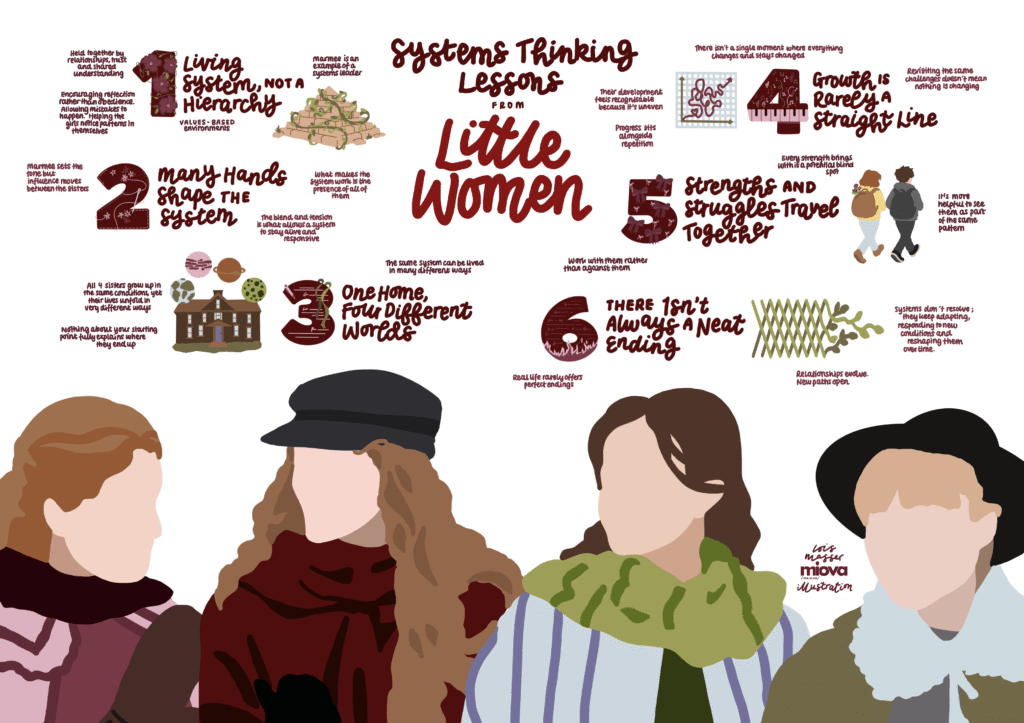
Little Women is a story about four sisters (Meg, Jo, Beth and Amy) growing up together. I think it’s beautiful. It perfectly captures themes of family, ambition, hardship and love.
Reading it recently, I started to notice something else this story captures – small patterns and dynamics that feel surprisingly familiar from systems work.
The March household is not just a backdrop for individual character development. It behaves more like a living system: the girls are shaped by relationships, values, interactions, tensions and learning over time. The sisters grow up in the same home, under the same influence of Marmee, with the same financial constraints and broadly the same moral grounding. And yet, they do not become the same people. Their lives diverge. Their strengths show up differently. Their struggles do too.
Lesson 1: The March Family is a Living System, Not a Hierarchy
At first glance, it would be easy to assume that Marmee is simply the leader of the household. She is the adult, the moral anchor and the person the sisters turn to. But she doesn’t lead in a particularly traditional or directive way.
Instead, Marmee’s character is an example to me of a systems leader. She shapes the conditions in which learning can happen. She encourages reflection rather than obedience. She allows mistakes to happen. She helps the girls notice patterns in themselves.
When Jo struggles with her temper, Marmee doesn’t simply correct her. She shares her own experience of anger, making the struggle visible and human rather than something to hide. There’s something gentle but powerful in that approach. When leading in systems, honesty and openness beat the image of perfection.
Rather than trying to control behaviour, Marmee shapes a values-based environment where behaviour can evolve. The family isn’t held together by rules or authority, but by relationships, trust and shared understanding.
This might mean focusing less on directing behaviour, and more on shaping the conditions that influence it.
In complex systems, that kind of leadership often matters more than control.
Lesson 2: Many Hands Shape the System
Although Marmee sets the tone, influence in the household doesn’t sit in one place. It moves between the sisters.
Each of them shapes the system, and each is shaped by it in return: Jo brings energy and imagination. She challenges expectations and pushes against what feels fixed. Meg offers steadiness and responsibility, grounding the family and connecting it to wider society. Beth brings care and emotional cohesion, often holding things together quietly. Amy introduces ambition and adaptability, helping the family stretch towards new possibilities.
None of these ways of being are complete on their own.
If Jo’s energy dominated entirely, things might feel chaotic. If Meg’s sense of order took over, the system might become constrained. Amy’s ambition without balance could tip into something narrower. Beth’s gentleness, on its own, might struggle to carry the weight of everything.
What makes the system work is the presence of all of them.
That feels familiar in systems too. Different perspectives don’t need to be resolved into one “right” way. Often, it’s the tension between them as well as the blend of different strengths that allow a system to stay responsive and alive. In practice, this might mean resisting the urge to align everyone too quickly, and instead making space for different perspectives to sit alongside each other.
Lesson 3: One Home, Four Different Worlds
All four sisters grow up in the same conditions. The same home. The same values. The same financial hardship. The same mother.
And yet, their lives unfold in very different ways.
Meg builds a life centred on stability and family. Jo pursues independence and creative work. Amy learns to navigate the social world with confidence and intent. Beth remains the emotional heart of the family.
Nothing about their starting point fully explains where they end up.
That’s something systems work reminds us of too. Even when people share the same environment, they experience and respond to it differently. Personality, timing, relationships and chance all play a role. It can be tempting to think that if we get the conditions right, outcomes will follow in predictable ways. But human systems don’t quite work like that. It’s not just the conditions that matter, but how each sister interacts with them, and with each other, over time.
It can mean being cautious about one-size-fits-all solutions, and paying closer attention to how different people are actually experiencing the same environment.
The same system can be lived in many different ways.
Lesson 4: Growth is Rarely a Straight Line
The sisters don’t grow in neat arcs. There isn’t a single moment where everything changes and stays changed.
Jo doesn’t overcome her temper once and for all. Amy’s maturity unfolds gradually. Meg continues to navigate the pull between aspiration and practicality.
Their development feels recognisable because it is uneven.
There are moments of insight, followed by moments of frustration. Progress sits alongside repetition, as patterns resurface and are responded to differently over time.
This is often what change looks like in complex systems too. Not a straight line, but a process of trying, noticing, adjusting and trying again. Sometimes circling back. Sometimes moving forward in ways that only make sense in hindsight.
There’s something reassuring in that. It reminds us that revisiting the same challenges doesn’t mean nothing is changing. It may simply mean the system is still learning. In practice, this might look like creating space to reflect on patterns over time, rather than expecting immediate or permanent change.
Lesson 5: Strengths and Struggles Travel Together
Each sister’s strengths are closely tied to her difficulties.
Jo’s independence fuels her creativity, but also her impatience. Meg’s sense of responsibility brings stability but can limit what feels possible. Amy’s ambition helps her adapt and grow but can tip into self-consciousness. Beth’s kindness holds the family together but is intertwined with feelings of fragility.
These are not separate qualities. They travel together.
In systems, we see similar patterns. The things that help a system function well can also create pressure points. A team that values harmony may struggle with conflict. A system that moves quickly may miss important signals. A culture that prizes independence may find collaboration harder.
We often see this in practice too. Tools like CliftonStrengths make this explicit: every strength brings with it a potential blind spot. Rather than trying to separate strengths from their possible downsides, it can be more helpful to see them as part of the same pattern. One way this shows up is noticing where a strength is overplaying and adjusting around it rather than trying to remove it altogether.
It’s more helpful to work with our struggles, rather than against them.
Lesson 6: There Isn’t Always a Neat Ending
One of the reasons Little Women still sparks conversation is that it doesn’t resolve in a perfectly tidy way.
Readers often have strong feelings about where the characters end up, particularly Jo. Some wish for a different outcome. Others see her path as a natural evolution.
But perhaps the discomfort says something useful.
We often expect stories (and systems) to land in a clear, satisfying place. A moment where everything fits. Real life rarely offers that.
The March family doesn’t arrive at a final, settled state. It changes shape over time. Relationships evolve. Loss is absorbed. New paths open.
The story doesn’t so much end as change and continue. That feels closer to how systems behave too. They don’t resolve; they keep adapting, responding to new conditions and reshaping themselves over time.
Closing reflection
What Little Women captures so well is not just the story of four sisters, but the feel of a human system.
A household shaped by values rather than control. A place where influence moves between people. Where growth happens unevenly. Where shared conditions lead to different outcomes. Where strengths and tensions sit side by side.
It’s not so different from the systems many of us work within.
And perhaps that’s why it resonates.
Sometimes the most helpful insights into systems don’t come from models or frameworks. They come from noticing patterns in stories, and recognising something of our own work reflected back at us – often in places we didn’t expect.
