
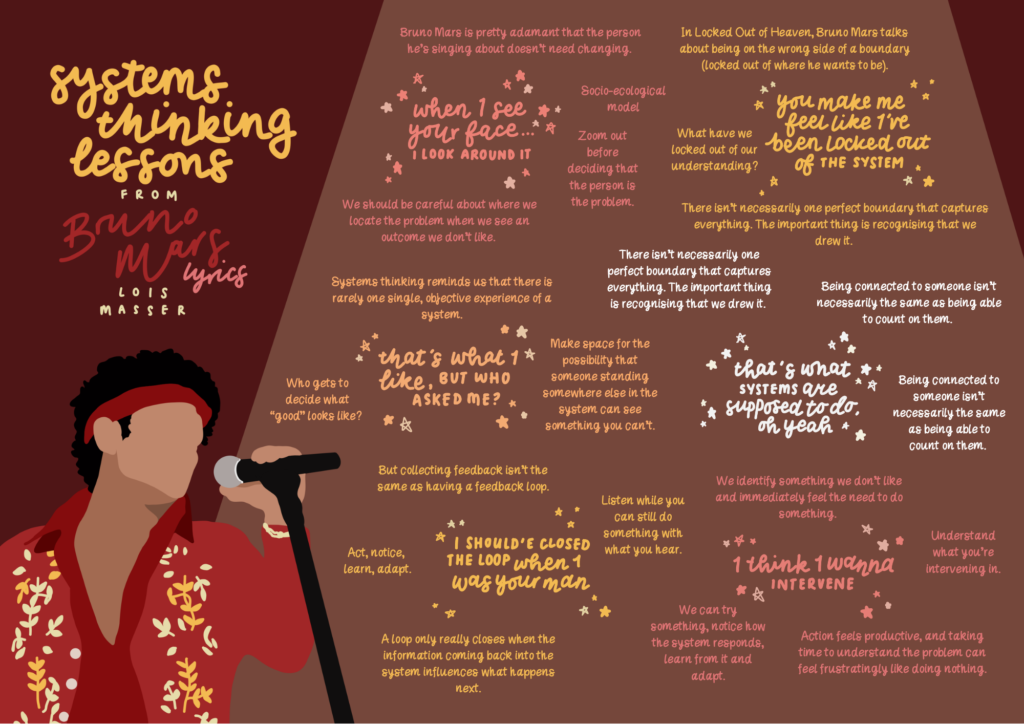
That’s What I Like: 6 Systems Thinking Lessons According to Bruno Mars
As far as I know, Bruno Mars has never released a song about leverage points. But if you listen with systems in mind, there are some surprisingly useful systems thinking lessons hiding in his music.
Systems thinking asks us to look beyond individuals and question the boundaries we might have helped create, seek different perspectives, pay attention to relationships, learn from feedback and resist the temptation to jump straight from problems to solutions. Bruno Mars, admittedly for very different reasons, has quite a lot to say about all those things.
So, in no particular order, here are six systems thinking lessons according to Bruno Mars.
When I See Your Face… I Look at What’s Around It
In Just the Way You Are, Bruno Mars is pretty adamant that the person he’s singing about doesn’t need changing. And maybe there’s a systems thinking lesson hidden in that. Not that people shouldn’t change and grow, but that we should be careful about where we locate the problem when we see an outcome we don’t like. Someone isn’t physically active enough, so we need to motivate them. Someone isn’t engaging with a service, so we need to persuade them. Someone isn’t making the “right” choice, so we need to educate them.
But systems thinking encourages us to zoom out before deciding that the person is the problem. Models such as the socio-ecological model remind us that behaviour doesn’t happen in isolation; it is shaped by relationships, communities, environments, organisations and wider policies. Suddenly, someone choosing not to exercise looks very different when we learn that they work long hours, can’t afford a gym membership, don’t feel safe walking in their neighbourhood, and have nowhere nearby that they actually enjoy being active. Their behaviour begins to make sense in the context of the system around them.
So perhaps, as Bruno would have it, there’s not a thing we need to change about you – at least not until we’ve stopped and asked what we could change about the conditions around you. Leave the individual alone for a minute and look around them.
You Make Me Feel Like I’ve Been Locked Out of the System
In Locked Out of Heaven, Bruno Mars talks about being on the wrong side of a boundary (locked out of where he wants to be). Systems thinking asks us to pay attention to the boundaries we draw too, although admittedly in a slightly less dramatic way. Whenever we try to understand a system, we make choices about what sits inside our field of enquiry and what sits outside it. We can’t possibly consider everything, so those boundaries are necessary. But they also shape what we’re able to see.
Imagine we’re trying to understand why people in a community aren’t physically active. We could draw our boundary around sport and leisure and look at gyms, sports clubs and activity programmes. But widen it slightly and suddenly schools, workplaces, parks, community groups and transport come into view. Widen it again and we might start noticing housing, income, perceptions of safety, relationships, culture or local policy. The problem hasn’t changed, but our understanding of what might be contributing to it has. And with that, the places where we might intervene change too. Perhaps the answer was never another exercise class at all.
There isn’t necessarily one perfect boundary that captures everything. The important thing is recognising that we drew it. Systems thinking encourages us to stay curious about what might be sitting just outside the edge of our current picture. What relationships haven’t we considered? What influences have we dismissed as irrelevant? Whose experience sits outside the way we’ve framed the problem? Where we draw the boundary effects what we see, what we think is causing the problem and, ultimately, where we look for solutions. So every now and then, it’s worth asking: what have we locked out of our understanding?
That’s What I Like, But Who Asked Me?
In That’s What I Like, Bruno Mars has a pretty clear idea of what good looks like. And there’s nothing wrong with that, until we start assuming that what we like, value or see as success must be what everyone else does too. Systems thinking reminds us that there is rarely one single, objective experience of a system. Where we stand within it influences what we see. Our experiences, assumptions, values and beliefs (sometimes called our mental models) shape what we notice, how we understand a problem and what we think should be done about it.
Take a local physical activity system. A funder might see success as increased participation numbers, while a health professional might focus on health outcomes. A community organisation might value stronger relationships and belonging, while for a resident, success might simply mean having somewhere nearby where they feel comfortable turning up. They’re all looking at the same system, but from different positions within it, and each perspective reveals something the others might miss. Systems thinking doesn’t necessarily ask us to decide which perspective is the “right” one. Instead, it encourages us to bring different perspectives together to build a richer picture of what is actually going on.
But there’s another question worth asking: who gets to decide what “good” looks like? Not every perspective carries the same amount of power. If one organisation’s definition of success determines the targets, funding and measures used across the system, it can quietly become the definition of success, even when the people experiencing the system value something completely different. So perhaps the systems thinking response to Bruno is: that’s what I like… but who asked me? Before deciding what the problem is, what success looks like or what needs to change, make space for the possibility that someone standing somewhere else in the system can see something you can’t.
That’s What Systems Are Supposed to Do, Oh Yeah
We often describe a system by listing the things within it: organisations, services, people, resources, policies and places. But a collection of parts isn’t really enough to tell us how a system works. Systems thinking asks us to pay just as much attention to what happens between those parts. Who talks to whom? Where does information travel? Who trusts whom? Who has influence? Where are relationships strong, and where are they missing altogether? Two places could have exactly the same organisations, funding and resources on paper and still behave completely differently because the relationships connecting those things are different.
That’s where Count on Me becomes particularly interesting. Being connected to someone isn’t necessarily the same as being able to count on them. We can draw a stakeholder map with neat lines connecting the council, NHS, schools, community organisations and local people, but those lines don’t tell us much about the quality of the relationships underneath them. Does information actually travel along them? Is there trust? Are relationships reciprocal? Can people disagree and still work together? Would the connection survive if one particularly well-connected person left their job? The strength, quality and pattern of these relationships can shape what the whole system is capable of doing.
Some of the things we care about most in systems change exist within these connections. Trust, collaboration, belonging and collective confidence aren’t things we can simply install in one organisation or hand to one individual; they emerge through interaction. In that sense, perhaps Count on Me offers one of the simplest reminders of what makes systems thinking different: don’t just look at what the system is made of. Look at how those things relate to and depend on one another. Sometimes the most important part of a system is what’s happening in the space between its parts.
I Should’ve Closed the Loop When I Was Your Man
When I Was Your Man is essentially a song full of feedback. Bruno can now see what he could have done differently, understands some of the consequences of what happened and has learned a great deal from the experience. There’s just one fairly significant problem: by the time he’s worked all of that out, it’s too late.
Systems produce feedback too. We collect data, run evaluations, speak to communities, hear from staff, receive complaints, notice patterns and learn from what happens. But collecting feedback isn’t the same as having a feedback loop. A loop only really closes when the information coming back into the system influences what happens next.
If we ask people what they think every year but continue doing exactly the same thing, we haven’t created much of a learning system. If an intervention produces an unexpected outcome, the useful question isn’t simply whether it “worked” or “failed”, but what that outcome can teach us about the system and what we might try differently next. Then we watch what happens again. Act, notice, learn, adapt.
There can also be delays between an action and its consequences. Something that looks successful today might create a problem six months from now, while an intervention that initially appears to achieve very little might slowly create relationships and conditions that lead to change much later. Systems thinking encourages us to keep paying attention rather than treating evaluation as something that happens once the work is finished. Listen while you can still do something with what you hear. Otherwise, like Bruno, we may end up understanding the feedback perfectly — just a little too late to use it.
I Think I Wanna Intervene
There is something wonderfully impulsive about Marry You. It’s a beautiful night, everyone’s looking for something to do and Bruno has landed on a major life decision. What could possibly go wrong?
Organisations can sometimes approach problems with a similar enthusiasm. We identify something we don’t like and immediately feel the need to do something. Launch a programme. Start a campaign. Commission some training. Create an app. Set up a working group. Pilot an intervention. It’s a beautiful night, we’re looking for something dumb to do, hey baby, let’s launch a quick-fix delivery programme. That doesn’t mean any of these things are bad, it just means we should take time to think – even though action feels productive, and taking time to understand the problem can feel frustratingly like doing nothing.
Systems thinking asks us to resist that urge, at least for a moment. Before deciding how to intervene, we can explore the patterns that have developed over time, the relationships connecting different parts of the system, the structures influencing behaviour and the assumptions sitting underneath them. If a system has been consistently producing a particular outcome, there is probably more going on than a missing programme waiting for us to invent it.
That doesn’t mean endlessly mapping a system until we’re too frightened to do anything. Complex systems can’t be completely understood before we act, and sometimes acting is how we learn. The difference is that our interventions become experiments rather than declarations that we’ve found the solution. We can try something, notice how the system responds, learn from it and adapt.
So perhaps the lesson from Marry You isn’t that spontaneous decisions are always a bad idea. It’s simply that before making a big intervention because “why not?”, it might be worth understanding what we’re intervening in.
Bruno Mars, Systems Thinker?
Probably not. At least, I’m fairly confident none of these songs were written with system boundaries or feedback loops in mind.
But that might be exactly why analogies like these are useful. Systems thinking can come with language that makes relatively human ideas sound complicated: mental models, boundaries, emergence, feedback loops, system conditions. Strip some of that terminology away and we’re being asked to do some quite understandable things.
Look around people, not just at them. Question what you’ve left outside the picture. Remember that where you stand affects what you see. Pay attention to the relationships between things. Listen to what happens next. And try to understand before you rush in to change things.
Maybe systems thinking isn’t about learning to see an entirely different world. Maybe it’s about learning to look at the world that’s already there a little differently.
And if Bruno Mars can help us do that, we probably can count on him after all.
